How to Take Sea Buckthorn Oil Softgel for Best Absorption






People often swallow a sea buckthorn oil softgel with water before breakfast, then decide after three weeks that nothing happened. The capsule is usually fine. The empty-stomach habit is the weak point.
The omega fatty acids and orange carotenoids in whole-berry oil are fat-soluble, so a meal that already contains some fat is what gives bile and pancreatic lipase a reason to work. Clock time matters less than that pairing.
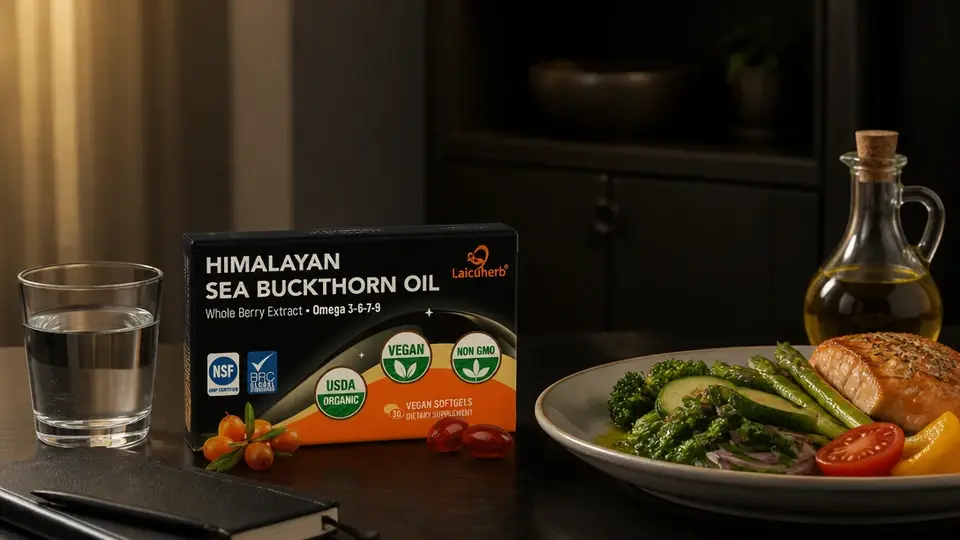
cardiovascular/himalayan-sea-buckthorn-oil">Laicuherb Himalayan Sea Buckthorn Oil is a vegan whole-berry softgel: two capsules per serving, 15 servings per bottle, 1000 mg oil from seed and pulp, extracted with low-temperature supercritical CO₂. The label lists Non-GMO, USDA Organic, and vegan declarations, and production in NSF cGMP and BRC certified facilities. Those facts describe the bottle. They do not prove absorption, and they do not turn 22 mg of plant ALA into fish-oil EPA and DHA.
Table of Contents
1. Quick Answer: Take With a Fat-Containing Meal for Best Absorption →
2. Why Fat-Soluble Nutrients Need Dietary Fat →
3. Best Time of Day: Morning vs. Evening →
5. What to Avoid (Other Fat-Soluble Supplements Timing) →
7. How to Tell If Your Absorption Is Working →
Quick Answer: Take With a Fat-Containing Meal for Best Absorption
Take the two-softgel serving of Laicuherb Himalayan Sea Buckthorn Oil with a meal that contains fat. For many people that is eggs, avocado, or full-fat yogurt at breakfast, or olive oil, nuts, or fish at dinner.
When fat from food reaches the small intestine, the gallbladder releases bile and the pancreas releases lipase. Those are the tools that break an oil into droplets your gut can take up. The stomach does not “excrete” bile. A water-only swallow still moves some fatty acids through. A fat-containing meal is the practical way to get more of the same capsule.
That meal effect is documented for other oils, not for this SKU. Lawson and Hughes found that EPA and DHA from fish-oil ethyl esters were absorbed about three times better with a high-fat meal than without one (Biochemical and Biophysical Research Communications, 1988) [1]. Sea buckthorn oil is a different triglyceride mix, and no published trial has measured an absorption ratio for this softgel. The takeaway is still useful: do not expect a magic percentage, and do not treat an empty-stomach week as a fair test of the oil you paid for.
Why Fat-Soluble Nutrients Need Dietary Fat
Palmitoleic acid (omega-7), linoleic acid, alpha-linolenic acid, oleic acid, beta-carotene, vitamin E, and plant sterols do not dissolve in the watery contents of the gut. Bile salts package lipids into micelles so those compounds can cross the intestinal wall.
A labeled serving here is 1000 mg of oil across two vegan capsules. That is a small fat load next to breakfast or dinner. On its own it may not be much of a signal for a full biliary response, which is why pairing the serving with food fat is the conservative habit.
The same logic shows up for vitamin D, another fat-soluble nutrient. Dawson-Hughes and colleagues gave healthy older adults a single vitamin D-3 dose with either a fat-containing breakfast or a fat-free breakfast and saw a 32% higher peak plasma vitamin D-3 with the fat meal (Journal of the Academy of Nutrition and Dietetics, 2015) [2]. That is a vitamin D-3 study, not a sea buckthorn study. It supports taking fat-soluble capsules with food. It does not quantify how much more of this 1000 mg serving you absorb.
Laicuherb uses the whole berry, seed and pulp together, so the serving carries both the seed-leaning omega-3 and omega-6 fatty acids and the pulp-leaning omega-7, carotenoids, and orange color [5]. The “take with fat” habit applies across that mix. Whole-berry chemistry is not a reason to skip the meal.
Best Time of Day: Morning vs. Evening
No published study shows that this sea buckthorn softgel works differently at 8 a.m. than at 7 p.m. Membrane fatty acids change over weeks. The useful question is which meal you will actually eat with fat, every day.
If breakfast already has eggs or yogurt, put both capsules there. If mornings are coffee and not much else, wait for the meal that has oil, nuts, or fish — often dinner. A few people get an oily aftertaste from any omega capsule; taking the serving with the larger meal often makes that quieter. Plant oil is not fish oil, so “fishy burps” are the wrong picture.
Published sea buckthorn oil trials have run for months, not mornings. Larmo and colleagues had adults take 2 g of a different oral sea buckthorn oil daily for three months while they tracked winter dry-eye measures (The Journal of Nutrition, 2010) [6]. That dose, formula, and endpoint are not this 1000 mg softgel, and the paper is not an absorption study. It is a reminder that three weeks on water before breakfast is a short, poorly designed test.
Can You Split the Dose?
The label serving is two vegan softgels, 15 servings in a 30-count bottle, 1000 mg oil [7]. You do not have to split that serving. Many people swallow both capsules with one fat-containing meal.
If the two capsules together feel heavy, or if a clinician has you taking more than the label serving, putting one capsule with breakfast fat and one with dinner fat is a reasonable workaround. Each swallow then rides with its own meal. Schuchardt and Hahn, reviewing long-chain omega-3 supplements, noted that spreading doses with meals can smooth plasma fatty acids across the day, while tissue levels still follow total intake over days and weeks (Prostaglandins, Leukotrienes and Essential Fatty Acids, 2013) [3]. That review is about marine omega-3s. Use it as meal-timing logic, not as proof that splitting this SKU changes your cells.
Do not cut, pierce, or squeeze a softgel. The vegan shell — tapioca starch, vegetable glycerin, and purified water — keeps the oil away from air and light. An opened capsule oxidizes quickly. If you want to split the serving, swallow each capsule whole at a different meal.
If you eat almost no fat, fast for long windows, or take medicines that change how meals work, ask the clinician who already follows those rules. hello@laicuherb.com can answer label and brewing-style product questions. It is not a substitute for that clinical conversation.
What to Avoid (Other Fat-Soluble Supplements Timing)
Fat-soluble compounds share digestive machinery. High doses arriving together can compete.
The clearest human example is carotenoids. Kostic, White, and Olson found that a large beta-carotene dose taken at the same time as lutein reduced lutein absorption (American Journal of Clinical Nutrition, 1995) [8]. This serving lists 150 mcg vitamin A as beta-carotene and 500 mcg natural carotenoids [7]. That is not the high-dose carotenoid study. If you also take a separate high-dose vitamin A, vitamin E, vitamin K, or lutein product, putting that product at another meal is the tidy habit. It is scheduling, not a toxicity scare.
Fish oil or krill oil is a different overlap. The product page describes whole-berry sea buckthorn oil as a vegetarian alternative to fish oil [7]. The chemistry is not the same: this serving has 22 mg ALA and no labeled EPA or DHA. Taking both is usually two omega stories, not a documented danger. It is also not a way to “stack” marine omega-3 status.
Orlistat and bile-acid sequestrants such as cholestyramine interfere with fat absorption. If you use those, ask a pharmacist how to space any oil capsule. A large psyllium dose can bind lipids in the gut; a few hours between the fiber and the softgels is a cautious gap. Those are inefficiencies and drug-label issues. They are not a reason to treat the oil as unsafe on its own.
Storage After Opening
Polyunsaturated oils oxidize. Light, air, and heat are the usual problems.
Albert and colleagues found that a large share of retail fish-oil products in New Zealand exceeded oxidation limits, often after poor storage in the supply chain or at home (Scientific Reports, 2015) [4]. That paper is about fish oil on shop shelves, not this bottle. Use it as a storage warning, not as a claim that your sea buckthorn oil is already rancid.
Close the lid. Keep the bottle in a cool, dark cupboard, away from the stove, dishwasher, and a sunny window. A steamy bathroom cabinet is a poor home. Refrigeration is not required; in a hot kitchen it can help. Cold capsules may feel firmer. Wait a minute, then swallow them whole.
Supercritical CO₂ is an extraction method without a solvent residue story. It does not prove the oil stays fresh after you leave the lid off. At the label dose of two capsules a day, a 15-serving bottle lasts about two weeks, not a month.
How to Tell If Your Absorption Is Working
This is a food-form oil, not a stimulant. You will not feel it “kick in” one morning, and that is the wrong test.
A fairer check is whether you can take both capsules with a fat-containing meal most days, without punching the shell, and without a week of oily discomfort that makes you quit. Published sea buckthorn oil studies have used weeks to months as observation windows, not three days [6]. Eight to twelve weeks is a reasonable habit review. It is not a promise that skin, lips, or eyes will change on a calendar.
If you want personal notes, write down how often you reach for moisturizer or how dry heated rooms feel, then look again later. Those notes are yours. They are not a clinical endpoint for this SKU, and they are not a substitute for drops, cream, or a clinician if dryness is sudden or severe.
Do not use an Omega-3 Index blood test as proof that this oil was absorbed. Harris and von Schacky defined that index as EPA plus DHA in red-cell membranes, in the setting of coronary-risk research (Preventive Medicine, 2004) [9]. This serving supplies 22 mg ALA. A change in EPA+DHA would not be a fair scorecard for Himalayan Sea Buckthorn Oil.
If you have taken the labeled serving with fatty meals for a full season and nothing you hoped for has moved, the usual explanations are an expectation the product was never designed to meet, or a problem that needs a doctor rather than a second bottle.
Conclusion
The useful routine is small. Take two capsules with the fattiest meal you actually eat. Pick a time you can repeat. Swallow the vegan shell whole. Park high-dose fat-soluble supplements and fat-blocking drugs at a different hour if you use them. Cap the bottle in a cool cupboard. Give the habit eight to twelve weeks before you judge it.
Laicuherb Himalayan Sea Buckthorn Oil gives you a whole-berry omega 3–6–7–9 profile, CO₂ extraction, and the quality paperwork on the product page [7]. How much of that oil you take up still depends on the meal around it.
FAQ
Q: Can I take Himalayan Sea Buckthorn Oil on an empty stomach?
A: You can. Some fatty acids still get through. Absorption is the practical reason to take the two-capsule serving with a fat-containing breakfast or dinner instead.
Q: How many softgels should I take, and how many are in a bottle?
A: One serving is two vegan softgels. The bottle holds 15 servings (30 capsules) and 1000 mg oil per serving [7]. If a clinician asks for more than the label, spacing extra capsules across two fat-containing meals is a reasonable way to take them whole.
Q: Does it need to be refrigerated after opening?
A: Refrigeration is not required. Store the closed bottle in a cool, dark, dry place away from heat and sun. At two capsules a day, one bottle is about a two-week supply.
Make Every Softgel Count with Laicuherb
Set the bottle next to the meal that already has fat. Swallow two capsules whole, put the lid back on, and keep the cupboard cool. If you want to review the habit, mark a date two to three months out and look at the notes you wrote on day one — not at a single morning.
Get the most from your daily serving — see how Himalayan Sea Buckthorn Oil is formulated → Himalayan Sea Buckthorn Oil
The whole-berry extract is taken from seed and pulp with low-temperature CO₂, filled in vegan softgels, and made in NSF cGMP and BRC certified facilities, with Non-GMO, USDA Organic, and vegan declarations on the product page [7]. Questions about meals or the label: hello@laicuherb.com.
References
1. Lawson, L. D., & Hughes, B. G. (1988). Absorption of eicosapentaenoic acid and docosahexaenoic acid from fish oil triacylglycerols or fish oil ethyl esters co-ingested with a high-fat meal. Biochemical and Biophysical Research Communications, 156(2), 960–963.
2. Dawson-Hughes, B., Harris, S. S., Lichtenstein, A. H., Dolnikowski, G., Palermo, N. J., & Rasmussen, H. (2015). Dietary fat increases vitamin D-3 absorption. <em>Journal of the Academy of Nutrition and Dietetics, 115</em>(2), 225–230. <a href="https://pubmed.ncbi.nlm.nih.gov/25441954/" style="color:#fb923c;text-decoration:underline;">Dietary fat increases vitamin D-3 absorption</a>
3. Schuchardt, J. P., & Hahn, A. (2013). Bioavailability of long-chain omega-3 fatty acids. Prostaglandins, Leukotrienes and Essential Fatty Acids, 89(1), 1–8.
4. Albert, B. B., Derraik, J. G. B., Cameron-Smith, D., et al. (2015). Fish oil supplements in New Zealand are highly oxidised and do not meet label content of n-3 PUFA. Scientific Reports, 5, 7928.
5. Yang, B., & Kallio, H. P. (2001). Fatty acid composition of lipids in sea buckthorn (Hippophaë rhamnoides L.) berries of different origins. Journal of Agricultural and Food Chemistry, 49(4), 1939–1947.
6. Larmo, P. S., Järvinen, R. L., Setälä, N. L., Yang, B., Viitanen, M. H., Engblom, J. R. K., Tahvonen, R. L., & Kallio, H. P. (2010). Oral sea buckthorn oil attenuates tear film osmolarity and symptoms in individuals with dry eye. <em>The Journal of Nutrition, 140</em>(8), 1462–1468. <a href="https://pubmed.ncbi.nlm.nih.gov/20554904/" style="color:#fb923c;text-decoration:underline;">Oral sea buckthorn oil and dry-eye study</a>
7. Laicuherb. <em>Himalayan Sea Buckthorn Oil.</em> <a href="https://www.laicuherb.com/cardiovascular/himalayan-sea-buckthorn-oil" style="color:#fb923c;text-decoration:underline;">Laicuherb Himalayan Sea Buckthorn Oil product page</a>
8. Kostic, D., White, W. S., & Olson, J. A. (1995). Intestinal absorption, serum clearance, and interactions between lutein and beta-carotene when administered to human adults in separate or combined oral doses. American Journal of Clinical Nutrition, 62(3), 604–610.
9. Harris, W. S., & von Schacky, C. (2004). The Omega-3 Index: a new risk factor for death from coronary heart disease? <em>Preventive Medicine, 39</em>(1), 212–220. <a href="https://pubmed.ncbi.nlm.nih.gov/15208005/" style="color:#fb923c;text-decoration:underline;">The Omega-3 Index study</a>
EDITORIAL HEALTH NOTE
This educational article does not replace individualized medical advice, diagnosis, medication guidance, or care from a qualified healthcare professional.
Related Readings
How Long Does Sea Buckthorn Oil Take to Work? A 12-Week Evidence Guide
Herbal Supplements for Postpartum Recovery: What's Safe to Consider
How to Read a Supplement Label: A Buyer's Guide for Herbal Teas and Softgels