How Long Does Sea Buckthorn Oil Take to Work? A 12-Week Evidence Guide






Table of Contents
1. Quick Answer: Skin Barrier Changes Typically Emerge at 4–8 Weeks
2. The Biology Behind Skin Lipid Renewal Cycles
3. Week 4: First Checkpoint — What to Look For
4. Week 8: Secondary Signs of Progress
5. Month 3: Full Assessment Point
After a bottle of cardiovascular/himalayan-sea-buckthorn-oil">Laicuherb Himalayan Sea Buckthorn Oil arrives, most people want to know when anything is supposed to feel different. That is a fair question, and it is also where oral oil and a night cream part ways. A cream sits on the surface the same evening. An oral softgel has to be swallowed, absorbed, and built into tissue that is still forming, which is why published sea buckthorn trials usually run for weeks to months and why they measured specific endpoints in specific groups rather than a personal glow date for this bottle.
Laicuherb Himalayan Sea Buckthorn Oil is a vegan whole-berry softgel: two capsules per serving, 15 servings per bottle, 1000 mg oil, with omega-7, omega-9, omega-6, and omega-3 amounts listed on the Supplement Facts panel [6]. Twelve weeks is a fair stretch to review whether that labeled serving still fits the rest of your routine. It does not mean the face will have finished three repair cycles by then.
Quick Answer: Skin Barrier Changes Typically Emerge at 4–8 Weeks
Four to eight weeks shows up often as a study window, which is easy to misread as the week your own facial barrier is supposed to change.
Oral sea buckthorn papers that people cite for timing usually look at volunteers after about one to three months. Larmo and colleagues gave postmenopausal women 3 g of sea buckthorn oil a day for three months and scored vaginal epithelium, not facial skin [1]. An earlier Larmo trial used the same three-month span for dry-eye measures [2]. Yang followed seed and pulp oils over months in people with atopic dermatitis, then looked at fatty-acid composition of skin lipids in a later paper [3][4]. Together those studies tell you how long the investigators watched. They do not tell you that Laicuherb Himalayan Sea Buckthorn Oil will change your barrier at week 4 or week 8.
If you are going to judge this bottle, give the labeled serving a full 12 weeks. The earlier checkpoints are there to see whether you can take it with food, not to hunt a result the trials never assigned to this product.
The Biology Behind Skin Lipid Renewal Cycles
The delay is easier to live with once the surface of skin is in view. The outer layer, the stratum corneum, is built from cells that matured as they moved up from deeper epidermis. That climb is measured in weeks and varies by body site and age. Milstone reviewed how the outer epidermis sheds and renews; it is slow surface turnover [5]. Fatty acids from food can be built into membranes of cells that are still forming, so the ones you feel at the surface are not the ones from this morning’s breakfast. An oral softgel does not change how skin feels over a weekend for that reason.
Laicuherb Himalayan Sea Buckthorn Oil supplies a measured serving of whole-berry oil. It does not speed that renewal, and it is not a cream you spread on dry patches.

 Realistic macro image of sea buckthorn berries and red softgels; no package is used in this ingredient-focused scene.
Week 4: First Checkpoint — What to Look For
By week 4 you have taken the labeled serving for about a month, which is long enough to ask whether the habit is real. Most days, were there two softgels? Were they taken with a meal that includes some fat, which is how fat-soluble nutrients are usually swallowed? Did the routine survive a normal week? Digestive discomfort that does not settle is a reason to stop and talk to a clinician rather than to double the dose.
Published oral sea buckthorn work does not give a reliable day-28 list for this product, such as less tightness after washing or less dryness around the nose. A phone note that simply records whether the capsules were taken is more useful than a glow score.
Questions on the label or serving: [hello@laicuherb.com](mailto:hello@laicuherb.com).
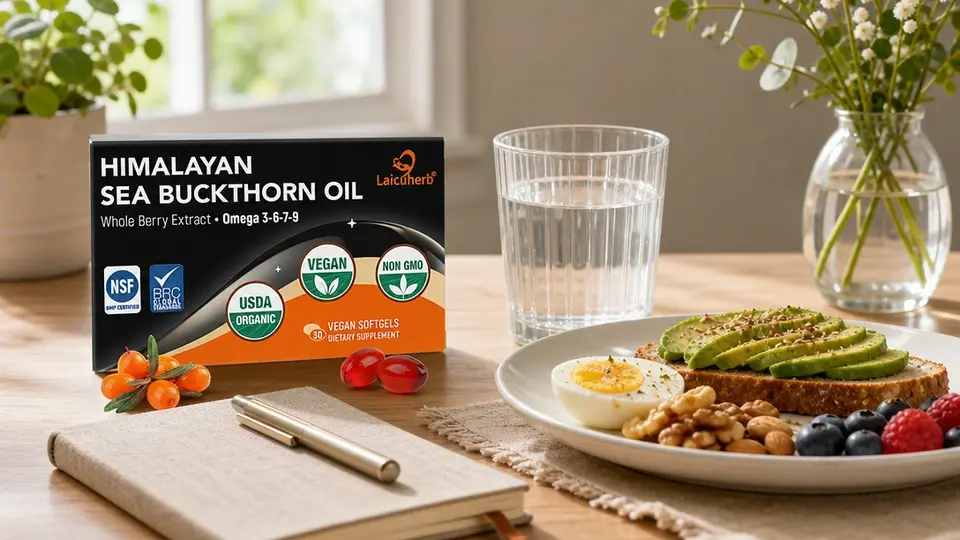
Realistic daily oral supplement routine using the authentic Laicuherb package.Week 8: Secondary Signs of Progress
Week 8 still sits inside the span where some of those trials were running, so it is tempting to look for a second, more visible chapter. Yang’s 2000 paper is the one usually pulled in here: it measured fatty-acid composition of skin lipids in people with atopic dermatitis after oral seed and pulp oils [4]. That is a laboratory readout in a clinical skin-disease group. It is not a forecast that cheeks, elbows, winter lips, or nail beds will look smoother on the eighth week of a 1000 mg Laicuherb serving.
If notes are still useful, keep them on consistency, meal timing, and whether anything felt off. A quiet mirror at week 8 does not close the case on the bottle.
Month 3: Full Assessment Point
Month 3 is a fair review point because that is how long several oral sea buckthorn trials lasted, not because three epidermal cycles have now been completed on a schedule.
Larmo’s 2014 trial ended at three months, used 3 g a day, and measured vaginal health in postmenopausal women [1]. The dry-eye trial also ran about three months [2]. The Laicuherb bottle is 1000 mg per labeled serving, so the dose, the endpoint, and the product are all different. At 12 weeks the honest question is smaller: does a daily oral oil still belong next to water, sleep, sunscreen, and a moisturizer you actually use?
If comfort or dryness has not shifted after 12 complete weeks of the labeled serving, review consistency and the rest of skincare, or stop. That finding does not prove the oil treated a disease, and it is not a reason to buy a second bottle in order to finish a protocol.
What Affects Your Timeline
Even a tidy 12-week calendar will not move the same way for every person, and most of the reasons have little to do with the Himalayan line on the label. Surface turnover slows with age. A diet already rich in oils, nuts, and fish leaves less room for one small capsule to look dramatic. Winter heat, cabin air, altitude, and sun all stress the surface from the outside. Taking Laicuherb Himalayan Sea Buckthorn Oil with food is ordinary absorption advice for an oil, and missed days simply stretch the review window. Sleep, smoking, and ongoing stress change how skin feels on their own. None of that turns a study length into a personal guarantee.
When to Switch Products vs. When to See a Doctor
If those 12 weeks stay quiet, pause and look at the routine before buying another oil. Missed capsules, empty-stomach doses, almost no water, no sunscreen, or a cleanser that already strips the face will flatten any oral habit. Switching supplements is a last step.
Seeing a clinician comes first when the skin problem looks medical: persistent itching, a spreading rash, cracked or bleeding skin, sudden severe dryness, or dryness that arrives with fever, night sweats, weight change, or a sharp shift in mood. Those belong with a dermatologist or the physician who already knows your chart. Laicuherb Himalayan Sea Buckthorn Oil is a daily oral oil for general adult use. It does not replace a prescription or a work-up.
Conclusion
Published oral sea buckthorn trials usually run weeks to months, and three months is a common observation window. Week 4 is for seeing whether the habit holds. Week 8 is still early. Month 3 is a fair time to decide whether the labeled serving still earns a place next to sleep, water, and topical care.
Laicuherb Himalayan Sea Buckthorn Oil is a vegan whole-berry softgel, two capsules, 15 servings, 1000 mg oil, with the facility and identity claims listed on the product page [6]. Use it as an oral oil on that schedule.
FAQ
Q: How many softgels per day and when should I take them?
A: The label is two vegan softgels per serving, 15 servings per bottle. Take them with a meal that includes some fat [6].
Q: Can I take Himalayan Sea Buckthorn Oil long-term?
A: It is sold as a daily oral softgel for ongoing adult use, including in dry environments. If you are pregnant, nursing, on prescription medicine, or managing a skin disease, take the Supplement Facts to the clinician who already follows you.
Q: What if I do not see any change after 12 weeks?
A: Review whether you took the labeled serving with food, and whether sunscreen and a basic moisturizer were in the routine. If dryness is severe, sudden, or paired with other symptoms, speak with a dermatologist or your physician rather than swapping oils.
REALISTIC 12-WEEK REVIEW
Use the labeled serving consistently, review at week 4 and week 8, and make a measured decision at month 3 rather than expecting a personal glow deadline.
Related Readings
Can You Drink Cycle Tea Every Day? Frequency and Dosage Guide
AUTHOR INFORMATION
Dr. Sarah Jenkins, MD, FACOG
Dr. Sarah Jenkins is a Board-Certified OB/GYN specializing in women's hormonal wellness, skin barrier biology, and the integration of botanical fatty acid nutrition for long-term mucosal and dermal vitality.
This article is intended for general educational information and does not replace personalized medical advice, diagnosis, or treatment.