Hormone Balance Tea and Ovulation Tracking: BBT, LH Tests, and Timing






Written & Reviewed by: Dr. Sarah Jenkins, MD, FACOG | September 15, 2026
Overview
A hormone balance tea and an ovulation test may appear in the same morning routine, but they answer different questions. BBT, urinary LH tests, and cervical-mucus observations can provide cycle information. A cup of tea cannot confirm ovulation, predict egg release, or change the meaning of a test strip.
This guide reflects general research and traditional herbal use. It does not constitute medical advice. Persistent or severe symptoms warrant consultation with a qualified healthcare professional.
Contents
- → Quick Answer: Tea Does Not Confirm Ovulation
- → What Basal Body Temperature Can and Cannot Show
- → What LH Tests Can and Cannot Show
- → How Cervical-Mucus Observations Fit
- → How to Log Tea Use Without Confusing Correlation with Effect
- → A Simple Ovulation-Tracking Table
- → When Absent or Irregular Ovulation Needs Care
- → About Laicuherb Bloom Hormone Balance Tea
- → FAQ
Quick Answer: Tea Does Not Confirm Ovulation
No beverage confirms ovulation. A sustained BBT rise can support the conclusion that ovulation probably happened after the fact. A positive urinary LH test suggests an LH rise and that ovulation may be approaching, but it does not prove that an egg was released. Cervical mucus can help identify the fertile window, but it is not a standalone confirmation either.
Bloom may be part of the routine around your tracking. It cannot create a positive LH test, raise or lower BBT in a diagnostic way, or verify that ovulation occurred. Collect the measurement first, then enjoy the tea.
What Basal Body Temperature Can — and Cannot — Show
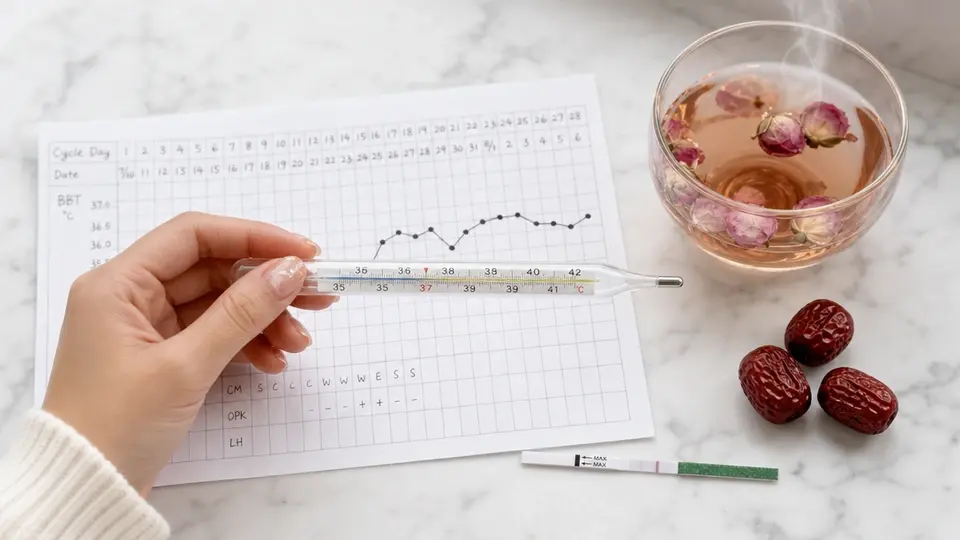
BBT is a retrospective marker. You take it immediately after waking, before getting out of bed, ideally after a sufficient period of sleep and under similar conditions each day. After ovulation, progesterone often raises resting temperature. A sustained rise over several days can support that ovulation probably occurred.
BBT does not reliably warn you hours before ovulation. It is more useful for looking back at cycle patterns and estimating the luteal phase than for identifying the exact moment an egg is released.
Fever, alcohol, illness, travel, interrupted sleep, a warm room, and drinking hot tea immediately before taking an oral temperature can all distort the chart. Take the measurement first, record it, and make Bloom afterward.
What LH Tests Can — and Cannot — Show
Urinary ovulation predictor kits detect luteinizing hormone. An LH rise often occurs before ovulation, so a positive result may indicate that the fertile window is open or approaching. It does not prove that ovulation will definitely occur or that follicular rupture has already happened.
Large amounts of fluid can dilute urine and make an LH rise harder to detect, but the right fluid restriction instructions vary by test. Do not dehydrate yourself to chase a darker line.
PCOS and other cycle patterns can make LH results harder to interpret. Rose, ginger, wolfberry, brown sugar, and red dates have not been shown to change urinary LH or make an ovulation test more accurate. Bloom can be consumed as a beverage, but it will not turn a negative strip positive.
How Cervical-Mucus Observations Fit — and Their Limits
Near the fertile window, some people notice mucus that is wetter, clearer, more slippery, or more stretchy. These observations can provide useful information before ovulation, but they are not perfect.
Infection, medication, hormonal contraception, stress, dehydration, semen, lubricants, and individual variation can all change what you see or feel. Record the sensation according to your chosen fertility-awareness method. Keep Bloom separate from that observation. Drinking the tea is not a substitute for checking your actual cycle signs.
How to Log Tea Use Without Confusing Correlation with Effect
A new tea can become an easy explanation for the next cycle change. Sleep, illness, travel, stress, weight changes, thyroid conditions, medications, and normal cycle variation can all affect the pattern.
Use separate fields. Record whether you drank Bloom in one column. Record BBT, LH result, cervical-mucus observations, sleep, illness, and symptoms in other columns. If a cycle looks different after you start Bloom, write down the timing without deciding the tea caused it. One or two observations show correlation at most.
Product questions can be sent to Laicuherb at hello@laicuherb.com, but medical interpretation belongs with a clinician.
A Simple Ovulation-Tracking Table
A useful table separates the markers instead of allowing an app to fill in missing information. Record the actual date, the BBT reading, the LH result, cervical-mucus observation, whether you drank Bloom, and anything that could affect the data.
| Date | BBT | LH Result | Mucus | Tea | Notes |
|---|---|---|---|---|---|
| Oct 1 | 97.3°F | Negative | Sticky | None | Woke late |
| Oct 2 | 97.3°F | Negative | Creamy | Bloom | Stressful day |
| Oct 3 | 97.2°F | Positive | Stretchy | Bloom | Tested at 2 p.m. |
| Oct 4 | 97.3°F | Positive | Stretchy | Bloom | Mild cramps |
| Oct 5 | 97.5°F | Negative | Wet | Bloom | Temperature rose |
| Oct 6 | 97.6°F | Negative | Dry | None | Slept 9 hours |
| Oct 7 | 97.6°F | Negative | Dry | Bloom | Premenstrual mood change |
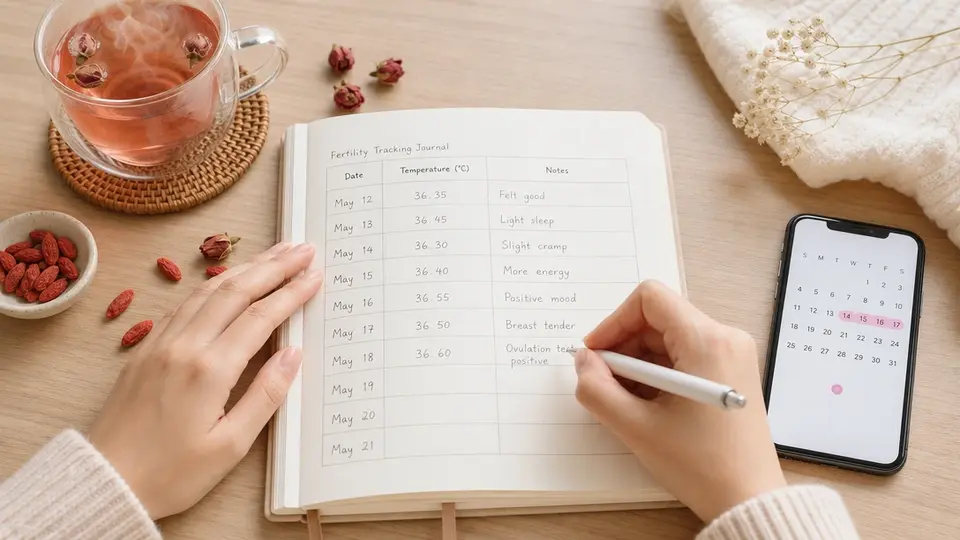
App predictions can be useful reminders, but they are estimates. After two or three cycles, bring the record to a clinician if the pattern is confusing, unusually irregular, or important to your health decisions.
When Absent or Irregular Ovulation Needs Care
Occasional anovulation can happen. Consider medical care if you miss three periods in a row, have cycles that repeatedly fall outside your usual pattern, have new or severe pelvic pain, experience unusually heavy bleeding, or repeatedly see LH positives that you cannot interpret.
Discuss with a clinician if:
- Cycles longer than 35 days or shorter than 21 days, especially when new or recurrent
- Three or more missed periods in a row
- Repeated LH positives over many days that are difficult to interpret
- New or severe pelvic pain, or unusually heavy bleeding
Anovulation and PCOS cannot be diagnosed from an app, tea, BBT chart, or LH strip alone. Bloom can be a comforting drink while you wait for an appointment, but it should not delay evaluation or be presented as a fertility treatment.
Conclusion
Ovulation tracking and hormone balance tea belong in different columns. BBT can help you look back for a sustained temperature shift. LH tests can identify an LH rise that may precede ovulation. Cervical mucus can provide another view of the fertile window. None of these markers is replaced or confirmed by a beverage.
Laicuherb Bloom Hormone Balance Tea is described as a rose, ginger, wolfberry, brown sugar, and red-date blend intended for the ovulatory phase. Use it as a warm ritual, not as a hormone regulator, fertility aid, or testing tool. Record the tea separately, follow your test instructions, and bring confusing or persistently irregular patterns to a clinician.
About Laicuherb Bloom Hormone Balance Tea
Bloom Hormone Balance Tea
Bloom is described as a non-hormonal herbal blend for the ovulatory phase, made with rose, ginger, wolfberry, brown sugar, and red dates. It is part of the Laicuherb Cycle Tea Set, alongside blends for other cycle phases.
Review the full ingredient panel, brewing details, and quality documentation on the Bloom product page. For questions about ingredients, sourcing, or orders, contact Laicuherb at hello@laicuherb.com.
Corporate Website: www.laicuherb.com
Frequently Asked Questions
Should an ovulation app count a cup of hormone balance tea as a fertile-window signal?
No. A tea should be recorded as a beverage, not as a fertility marker. An app may estimate the fertile window from cycle dates or use data such as BBT, LH results, and cervical-mucus observations, depending on its design. Drinking Bloom should not be entered as evidence that ovulation occurred or that the fertile window changed.
When should I drink Bloom Tea in relation to LH test timing and fluid intake?
Follow the instructions for your specific LH test. Avoid drinking a large amount of fluid immediately before testing if the instructions warn that dilution can affect the result. Do not intentionally dehydrate yourself. A practical sequence is to collect and test the urine as directed, read the strip within the stated time window, record the result, and then drink Bloom.
Can false-positive LH tests be caused by tea or by long cycles?
Bloom has not been shown to cause false-positive LH tests. Long or irregular cycles can make the best testing days harder to predict, and PCOS or other conditions can complicate LH interpretation. If you see positive results for many days or your cycle pattern is repeatedly unusual, ask a healthcare professional to review the results rather than assuming the tea changed your hormones.
References
[1] Su HW et al. (2017). Detection of ovulation: A review of currently available methods. Bioengineering & Translational Medicine, 2(3), 238–246.
[2] Najmabadi S et al. (2020). Cervical mucus patterns and the fertile window in women not using any contraception. J Women's Health, 29(12), 1554–1561.
[3] Ecochard R et al. (2015). Self-identification of the clinical fertile window and the ovulation period. Fertil Steril, 103(5), 1319–1325.
[4] Blackwell LF et al. (2013). Hormonal monitoring of ovarian activity using the Ovarian Monitor. Hum Reprod, 28(3), 750–758.
[5] Barron ML & Fehring RJ. (2005). Basal body temperature assessment. JOGNN, 34(2), 254–260.
[6] Direito A et al. (2013). Relationships between the LH surge and other menstrual cycle characteristics. Front Public Health, 1, 53.
Related Readings
Feminine Moisture Supplement: When Intimate Dryness Needs Medical Care
Read Article →
Setting Industry Benchmarks: Certified Gluten-Free, Non-GMO and Vegan Sea Buckthorn Oil
Read Article →
Must-Have Sea Buckthorn Oil for Dryness: Analyzing the Benefits for Long-Term Vitality
Read Article →