Herbal Tea and Male Fertility: What the Research Says






Some men, after months of trying, start looking for a drink they can add to the day — herbal tea for male fertility, antioxidants and sperm. The pages that come up often sound more certain than the papers behind them.
The biology those pages lean on is real enough. Oxidative stress can damage sperm, and compounds in plants such as schisandra and green tea have shown antioxidant activity in cells and animals. What has not been shown, in a well-designed human trial, is that a cup of herbal tea raises the chance of conception.
That gap is why this article stays with the evidence, and with what the cup actually is. Laicuherb 7 Days Bliss Tea is a caffeine-free daily blend of schisandra berry, astragalus root, codonopsis root, jujube seed, raspberry fruit, and stevia leaf: 8 g per bag, ten bags in a box, sold for steady energy and everyday vitality. It is not a fertility treatment.
Table of Contents
2. How Oxidative Stress Affects Sperm →
3. Schisandra and Antioxidant Activity: What Lab Studies Show →
4. Green Tea EGCG and Male reproductive health →
5. What the Research Does NOT Support →
6. Medical Fertility Evaluation: What to Do Before Relying on Supplements →
9. Build a Calmer Daily Ritual with Laicuherb While You Get Real Answers →
Quick Answer: Some Herbal Compounds Have Been Studied for Oxidative Stress and Sperm Quality — Evidence Is Preliminary
The search usually starts with oxidative stress. Some plants contain compounds that reduce reactive oxygen species in laboratory dishes. Reducing those molecules in a dish is not proof that any herbal tea improves conception.
The widest look at the antioxidant question is still a Cochrane review of oral antioxidant supplements in subfertile men, not tea. Smits and colleagues included 61 randomized trials and 6,264 men (Cochrane Database of Systematic Reviews, 2019, CD007411). Antioxidants may have improved live-birth rates, but the authors rated the evidence low quality. Only seven small trials reported live birth, and when studies at high risk of bias were removed, the live-birth advantage was no longer there [3].
The following year, Steiner and colleagues published the Males, Antioxidants, and Infertility (MOXI) randomized trial of a standard antioxidant capsule versus placebo in men with male-factor infertility (Fertility and Sterility, 2020). That trial did not show a benefit for semen parameters or pregnancy [4]. Both papers describe concentrated supplement formulas. They are not a green light for a tea bag, and they are not a reason to skip a semen analysis.
If a caffeine-free blend such as 7 Days Bliss Tea has a place, it is as a daily drink after that workup, not as a stand-in for it.
How Oxidative Stress Affects Sperm
Those searches keep circling antioxidants because of how a sperm cell is built. The outer membrane is rich in polyunsaturated fatty acids, which helps the cell move and also makes it a target for reactive oxygen species from metabolism, heat, smoking, obesity, illness, and some environmental exposures.
A sperm cell also carries very little cytoplasm, so it has fewer of the cleanup enzymes other cells use. Agarwal, Saleh, and Bedaiwy reviewed how excess reactive oxygen species can impair motility, damage DNA, and reduce the sperm’s ability to fuse with an egg (Fertility and Sterility, 2003) [1]. Tremellen later framed oxidative stress as a clinical issue in male infertility, not only a laboratory finding (Human Reproduction Update, 2008) [2].
That is why fruit, vegetables, and herbal infusions come up when someone asks what to drink. Overall diet and lifestyle can change antioxidant load. One cup of tea has not been shown to change a semen-analysis number.

Schisandra and Antioxidant Activity: What Lab Studies Show
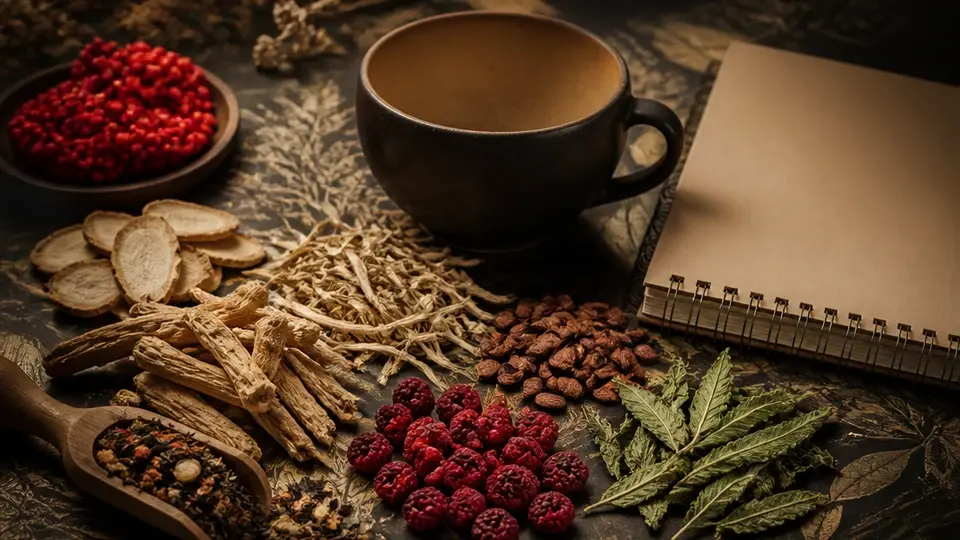
Among the plants that show up in those papers, Schisandra chinensis is the one in 7 Days Bliss Tea with the longest trail. The characteristic lignans, including schisandrin and gomisin, have been studied for decades, much of that work in concentrated extracts.
Panossian and Wikman reviewed Russian research on schisandra in Journal of Ethnopharmacology in 2008. The overview covers free-radical scavenging and effects on the body’s own antioxidant enzymes in cell and animal models, at extract doses that do not map onto one 8 g tea bag [5]. Those papers do not measure sperm count, motility, or pregnancy in men who drink tea.
There is no published human trial showing that schisandra tea changes semen parameters. The chemistry supports a narrower claim: schisandra is an antioxidant-rich plant, which is a fair reason it appears in a daily vitality blend, and not a reason to call the blend a fertility product. Whether a caffeine-free schisandra tea fits next to a clinician’s plan is a question for the clinic. Brewing and ingredient questions can go to hello@laicuherb.com.
Green Tea EGCG and Male Reproductive Health
The same search pages almost always mention green tea, even though 7 Days Bliss Tea does not contain it. The reason is its main catechin, epigallocatechin gallate (EGCG), one of the most studied plant antioxidants. Roychoudhury and colleagues reviewed that literature in Reproductive BioMedicine Online in 2017: EGCG can protect sperm from oxidative damage in vitro, and green-tea extract improved some sperm measures in mouse experiments. The same review said human data are sparse and dose matters [6].
Dose still cuts both ways. Green-tea leaf extract in adult male rats has been linked to lower testicular weight, sperm motility, and sperm count in experimental work (Chandra and colleagues, Indian Journal of Experimental Biology, 2011) [7]. That is extract in animals, not a supermarket tea bag, and it is a reminder that more antioxidant is not automatically a fertility strategy.
Because this blend has no green tea and no caffeine, men who already drink coffee, or who have been told to ease stimulants during a workup, are looking at a different cup. The green-tea literature still matters as a pattern: encouraging results in cells and mice, thin human data, and a wide gap between extract milligrams and a brewed bag.
What the Research Does NOT Support
The same pattern shows up when the question moves from “what has been studied” to “what has not.”
No adequately powered randomized trial has tested a brewed herbal tea against sperm count, motility, morphology, or pregnancy in men. The research also does not show that antioxidants fix a varicocele, a hormone problem, a blocked duct, or a genetic cause. Those need diagnosis, and some of them need procedures, not another infusion.
Megadosing sits in the same gap. Rat work on green-tea extract and mixed human data on high-dose vitamin capsules both point to a ceiling, past which extra antioxidant is useless or unhelpful [3][4][7].
The 7 Days Bliss Tea product page describes the blend as support for steady daily energy, focus, and everyday vitality [8]. This article stays with that description. Anyone selling an herbal tea as a cure for male infertility is ahead of the evidence.
Medical Fertility Evaluation: What to Do Before Relying on Supplements
Before any of those daily habits, the step that actually changes the picture is a workup.
A semen analysis following the World Health Organization laboratory handbook (6th edition, 2021) reports concentration, motility, and morphology against reference ranges, and can include DNA fragmentation or oxidative-stress measures when the clinician asks for them [9]. The American Urological Association and the American Society for Reproductive Medicine recommend evaluating both partners after twelve months of trying, after six months if the female partner is over 35, and sooner when there is a known risk such as undescended testes, chemotherapy, or prior genital surgery [10].
A urologist can check for a varicocele, run hormones, and review medicines that quietly affect sperm production, including exogenous testosterone, some antidepressants, and some blood-pressure drugs. Once that picture exists, sleep, alcohol, heat from laptops, and vegetables are easier to judge. A caffeine-free cup such as 7 Days Bliss Tea can be one small part of that later layer, after the assessment, not instead of it.
Conclusion
Herbal tea and male fertility share a plausible biology and a thin human record. Oxidative stress can harm sperm, and schisandra, green-tea catechins, and other plant compounds show antioxidant activity in cells and animals. What is missing is a trial in which a brewed tea improves semen parameters or pregnancy in men.
Until that trial exists, no tea should be chosen on a fertility promise. Laicuherb 7 Days Bliss Tea is a caffeine-free daily blend built around schisandra and supporting roots, positioned for steady energy and everyday vitality. If the ritual fits, drink it for that. The question a search bar cannot answer still belongs with a semen analysis.
FAQ
Q: Does 7 Days Bliss Tea improve sperm quality or fertility?
A: No. There is no clinical trial of this tea on sperm or pregnancy. It is a caffeine-free daily mix for consistent energy and vitality. Schisandra and raspberry fruit are antioxidant-rich plants. That chemistry has not been tested as a reproductive outcome in men who drink the tea.
Q: How do I brew it?
A: Steep one 8 g tea bag in 240 ml of water at 80 to 100°C for 5 to 10 minutes and drink it warm. Honey or lemon is optional. The bag is for brewing and drinking.
Q: Is it safe to drink while undergoing fertility testing or treatment?
A: It is caffeine-free, vegan, and gluten-free. Natural is not a clinic clearance. People respond differently to herbs, and some fertility protocols limit extra products. Ask the doctor or clinic before adding any herbal tea.
Build a Calmer Daily Ritual with Laicuherb While You Get Real Answers
A fertility stretch already has enough uncertainty. Book the semen analysis, see the urologist, and then decide which small daily habits are worth keeping. If a warm, caffeine-free cup of schisandra, astragalus, and codonopsis is one of those habits, that is a drink, not a diagnosis.
If you want an antioxidant-rich daily ritual while you wait for clinical answers, see 7 Days Bliss Tea. Each box holds ten 8 g bags. The blend is vegan, gluten-free, and caffeine-free. Questions about ingredients or brewing: hello@laicuherb.com.
References
1. Agarwal, A., Saleh, R. A., & Bedaiwy, M. A. (2003). Role of reactive oxygen species in the pathophysiology of human reproduction. Fertility and Sterility, 79(4), 829–843. Verified source
2. Tremellen, K. (2008). Oxidative stress and male infertility: a clinical perspective. Human Reproduction Update, 14(3), 243–258. Verified source
3. Smits, R. M., Mackenzie-Proctor, R., Yazdani, A., Stankiewicz, M. T., Jordan, V., & Showell, M. G. (2019). Antioxidants for male subfertility. Cochrane Database of Systematic Reviews, 2019(3), CD007411. Verified source
4. Steiner, A. Z., Hansen, K. R., Barnhart, K. T., et al. (2020). The effect of antioxidants on male factor infertility: the Males, Antioxidants, and Infertility (MOXI) randomized clinical trial. Fertility and Sterility, 113(3), 552–560. Verified source
5. Panossian, A., & Wikman, G. (2008). Pharmacology of Schisandra chinensis Bail.: an overview of Russian research and uses in medicine. Journal of Ethnopharmacology, 118(2), 183–212. Verified source
6. Roychoudhury, S., Agarwal, A., Virk, G., & Cho, C. L. (2017). Potential role of green tea catechins in the management of oxidative stress-associated infertility. Reproductive BioMedicine Online, 34(5), 487–498. Verified source
7. Chandra, A. K., et al. (2011). Effect of green tea (Camellia sinensis L.) leaf extract on reproductive system of adult male albino rats. Indian Journal of Experimental Biology, 49(9), 689–697.
8. Laicuherb. 7 Days Bliss Tea. Verified source
9. World Health Organization. (2021). WHO laboratory manual for the examination and processing of human semen (6th ed.). Verified source
10. Schlegel, P. N., et al. (2020, amended 2024). Diagnosis and treatment of infertility in men: AUA/ASRM guideline. American Urological Association. Verified source
EDITORIAL HEALTH NOTE
This educational article does not replace semen analysis, fertility evaluation, diagnosis, treatment, or individualized advice from a qualified healthcare professional.
Related Readings
Men Over 40: How Sleep and Stress Change—and What Herbal Tea Can Realistically Do
How Long Does Sea Buckthorn Oil Take to Work? A 12-Week Evidence Guide