Why Do I Feel So Tired the Week Before My Period?






Table of Contents
Quick Answer: Why Luteal Phase Drains Your Energy →
The Hormone Shift Behind Premenstrual Fatigue →
How Progesterone Affects Sleep Quality →
When Fatigue Is a Normal Phase Response (vs. a Red Flag) →
What Research Says About Herbal Support →
After ovulation, progesterone rises, core temperature ticks up a little, and sleep can feel lighter or more broken for some people [1][2]. Energy in the daytime often follows that night.
Laicuherb Rest Calm & Sleep Tea is a luteal-phase evening blend: cinnamon, nettle leaf, raspberry fruit, ginger, spearmint, lemongrass, ashwagandha, and radix asparagi, 8 g × 10 bags, caffeine-free as listed [5]. The product page is clear: it does not change hormone levels or treat PMS. It is a warm herbal beverage for a slower evening, not a sleeping pill [5].
Quick Answer: Why Luteal Phase Drains Your Energy
The luteal phase runs from ovulation to the next period. Progesterone in this window is thermogenic: basal temperature is often a fraction of a degree higher than in the follicular phase [1][2]. Some studies also report a modest rise in resting energy use in the luteal phase. Neither finding is a personal calorie target. Together they help explain why the same day can feel more expensive.
Sleep architecture can shift in the same window—more awakenings, less of the “I slept through” feeling—even when time in bed looks similar [2]. Tiredness the next day is then unsurprising.
A warm, caffeine-free cup can be part of how you close the day. That is ritual and fluid. It is not evidence that Rest Tea restores luteal energy or rewrites the hormone curve [5].
The Hormone Shift Behind Premenstrual Fatigue
In a typical ovulatory cycle, estrogen rises toward ovulation. After ovulation, progesterone from the corpus luteum dominates until, if there is no pregnancy, both hormones fall before menses [1]. People describe fog, heaviness, or a shorter fuse in that stretch. Intensity varies cycle to cycle.
Those shifts are real. They are also not a lab order you can fill with nettle or raspberry in a tea bag. Those plants are on this label for flavor and traditional use in a beverage [5]. They are not a documented “nutrient replacement” for the luteal drop.
If fatigue is new, extreme, or paired with other red-flag signs, the question is medical, not botanical. See the section below.
How Progesterone Affects Sleep Quality
Progesterone is often called calming. In the luteal phase it also raises core temperature slightly, which can work against the cooling many people need to settle into deeper sleep [2]. Lighter sleep and more night wakings show up in menstrual-cycle sleep research for some, not all, women [2].
Rest Tea sits in that evening slot as minty-spiced, caffeine-free warmth—cinnamon, spearmint, ginger, lemongrass, ashwagandha, and the rest of the listed herbs [5]. Ashwagandha extract has been studied for sleep at capsule doses (often hundreds of milligrams per day in trials) [4]. A steeped bag is not those trials. Do not copy extract milligrams onto this infusion.
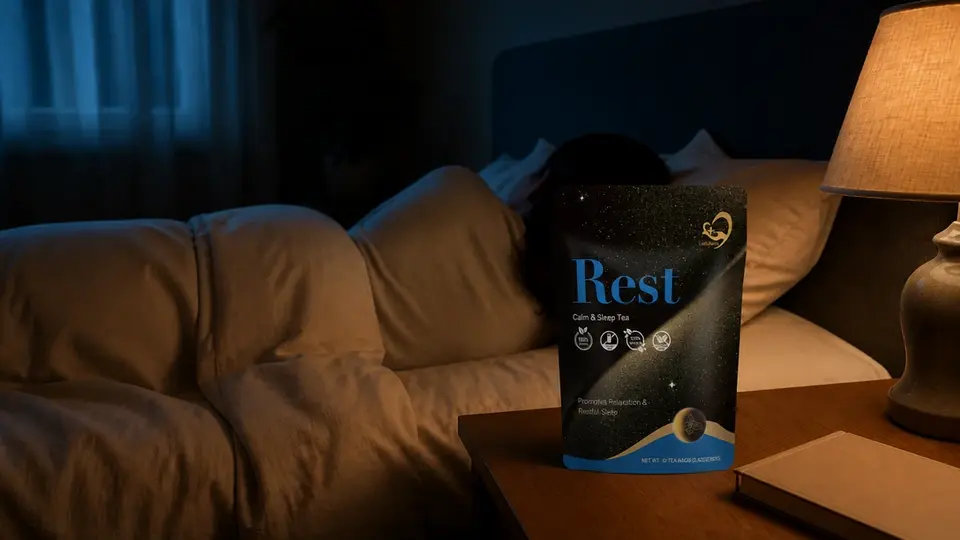

Realistic evening bedroom scene representing cooler, darker sleep conditions.
If you use caffeine earlier in the day, that is a separate choice. Late caffeine can make the next night harder for many people. Rest Tea does not cancel a late espresso, and espresso is not “wrong”—timing is just part of the same sleep picture.
For brew questions: hello@laicuherb.com. For insomnia that wrecks work or mood: a clinician.
When Fatigue Is a Normal Phase Response (vs. a Red Flag)
Tiredness that eases once bleeding starts, and still lets you function, is often discussed as a cycle-linked pattern. That is a description, not a diagnosis.
Get medical care rather than another bag if fatigue is disabling, or if you also have dizziness, shortness of breath, fainting, marked hair loss, unexplained weight change, very heavy bleeding, or mood that includes hopelessness. Iron deficiency, thyroid disease, depression, and other conditions sit in the same calendar month as PMS. A tea routine does not sort them [5].
Pregnant, breastfeeding, on thyroid medicine, sedatives, or immunosuppressants: ask a clinician before adding ashwagandha-containing products [5].
What Research Says About Herbal Support
Cycle science (temperature, sleep, ovulation timing) is stronger than finished-tea science [1][2].
Ashwagandha root extract has randomized data on stress and, in a 2021 meta-analysis, sleep-related scores—at extract doses and in people who often already had sleep complaints [4]. Ginger and cinnamon are widely studied for other endpoints (digestion, flavor, culinary use). None of that is an RCT of Rest Calm & Sleep Tea for premenstrual fatigue.
Honest limit: there is no clinical trial showing this eight-herb bag treats PMS, fixes hormones, or restores luteal energy [5]. What you can say is narrower: caffeine-free, food-grade herbs, luteal-phase evening positioning, brew only.
Practical Energy Management in the Luteal Phase
Useful levers are ordinary: enough food (appetite can rise in this phase), daylight, a realistic task load, and a cooler, darker bedroom if you run warmer at night [2]. Light movement is still movement. A short walk is not a moral upgrade over rest if rest is what you have.
If you drink coffee or Pure Tea (green tea, caffeinated) earlier, keep the clock in mind so evening is not a second stimulant. Rest Tea is the caffeine-free cycle cup in this set [5]. Use it as a timed pause: one sachet, package steep, lights down. That is habit design. It is not a metabolic protocol.
Conclusion
Feeling wiped the week before a period has a physiology: luteal progesterone, a small temperature rise, sleep that can fragment, days that cost more [1][2]. Rest Calm & Sleep Tea is a luteal evening beverage—8 g × 10, listed herbs, no caffeine on the formula—not a treatment for PMS, hormones, or fatigue [5].
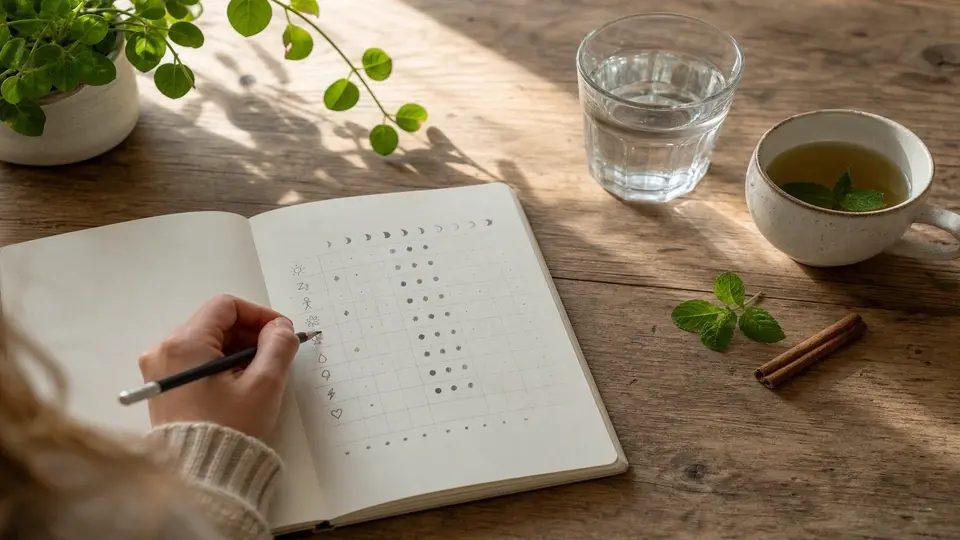
Realistic personal tracking scene for sleep and energy observations.
Track how you sleep and function. If the picture is mild and cyclical, a slower night plus a warm cup is a personal routine. If it is severe or mixed with red flags, skip the longer steep and book care.
FAQ
Question
When is the best time to drink Rest Calm & Sleep Tea?
Answer
The product is positioned for the luteal phase (after ovulation until bleeding starts), as an evening brew. Follow the package. It is not a prescribed sleep dose [5].
Question
Can this tea be used for cooking or applied topically?
Answer
No. It is for brewing and drinking only [5].
Question
Does this tea cure premenstrual syndrome or eliminate fatigue?
Answer
No. It is not intended to diagnose, treat, cure, or prevent any disease. It does not change hormone levels or treat PMS [5].
Q: When is the best time to drink Rest Calm & Sleep Tea?
A: The product is positioned for the luteal phase (after ovulation until bleeding starts), as an evening brew. Follow the package. It is not a prescribed sleep dose [5].
Q: Can this tea be used for cooking or applied topically?
A: No. It is for brewing and drinking only [5].
Q: Does this tea cure premenstrual syndrome or eliminate fatigue?
A: No. It is not intended to diagnose, treat, cure, or prevent any disease. It does not change hormone levels or treat PMS [5].
Experience Gentle Cycle Harmony with Laicuherb
If the week before your period is when you want a caffeine-free, minty-spiced evening cup, Rest Calm & Sleep Tea is built for that window: cinnamon, spearmint, ginger, ashwagandha, and the rest of the listed botanicals, 10 bags [5].
Keep medical questions with a clinician. Product questions: hello@laicuherb.com.
Rest Calm & Sleep Tea product page →
References
[1] Reed, B. G., & Carr, B. R. (2018). The normal menstrual cycle and the control of ovulation. In K. R. Feingold et al. (Eds.), Endotext. MDText.com. Source →
[2] Baker, F. C., & Driver, H. S. (2007). Circadian rhythms, sleep, and the menstrual cycle. Sleep Medicine, 8(6), 613–622. Source →
[3] Freeman, E. W. (2003). Premenstrual syndrome and premenstrual dysphoric disorder: definitions and pathogenesis. Psychoneuroendocrinology, 28(Suppl 3), 25–37. Source →
[4] Cheah, K. L., Norhayati, M. N., Husniati Yaacob, L., & Abdul Rahman, R. (2021). Effect of ashwagandha (Withania somnifera) extract on sleep: A systematic review and meta-analysis. PLOS ONE, 16(9), e0257843. Source →
[5] Laicuherb. Rest Calm & Sleep Tea. Source →
Related Readings
How to Choose the Best Sleep Support Supplements for You? →
AUTHOR & MEDICAL REVIEW
Written & Reviewed by: Dr. Sarah Jenkins, MD, FACOG
Dr. Sarah Jenkins is a Board-Certified OB/GYN with a specialized focus on women's hormonal health, menstrual cycle harmony, and the integration of holistic botanical approaches to reproductive wellness and mucosal hydration.