Inner Beauty Supplement vs Collagen Peptides: Different Layers, Different Jobs






This article reflects general health science and traditional botanical literature. It does not replace professional medical advice.
Table of Contents
→ Quick Answer: Different Layers, Different Goals
→ What Collagen Peptides Target: The Dermal Scaffold
→ What Sea Buckthorn Omega-7 Targets: The Epidermal Lipid Barrier
Two bottles, one question: collagen peptides or a plant oil sold as inner beauty. Laicuherb Skin Glow Supplement is not collagen. It is USDA Organic whole sea buckthorn oil in vegan softgels — 2 capsules, 1000 mg oil, 324 mg omega-7 (palmitoleic acid) per serving, 15 servings per bottle [6]. Hydrolyzed collagen is animal or marine protein broken into peptides.
They are different jobs. They are not two strengths of the same glow pill. Skin Glow does not replace moisturizer, sunscreen, or a dermatologist, and it is not intended to diagnose, treat, cure, or prevent any disease [6].
Quick Answer: They Work on Different Skin Layers — Choose Based on Your Primary Goal
Collagen in textbooks is the main structural protein of the dermis. Hydrolyzed peptide trials usually measure wrinkles, elasticity, or dermal matrix markers on specific peptide products over weeks — not every powder on a shelf [1][3].
Sea buckthorn oil is a lipid. Palmitoleic acid and other fatty acids in pulp and whole-berry oil are discussed for membranes and surface moisture, not as amino acids for a collagen lattice [4][5]. Skin Glow’s own page says it is not a collagen supplement [6].
“Layers” here is a map of what each ingredient class is, not proof that one bottle only hits dermis and the other only hits epidermis in your face. Choose by category: protein peptides versus plant oil.
What Collagen Peptides Target: The Dermal Scaffold
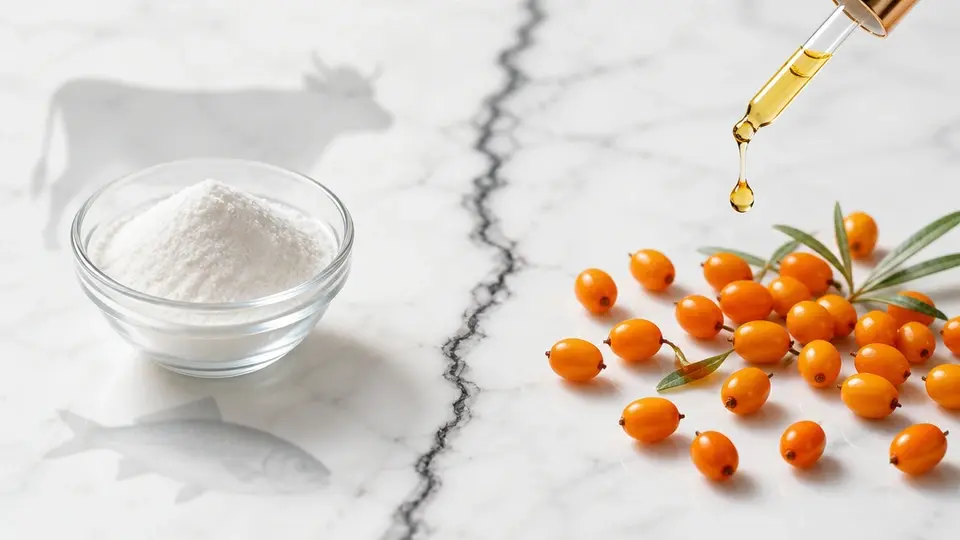
Collagen is abundant in dermal connective tissue. With age and UV, native production falls; skin can look less firm. Hydrolysis cuts collagen into shorter peptides so the gut can absorb amino acids and small peptides.
Oral studies of named bioactive collagen peptides have reported changes such as reduced eye-area wrinkles and higher markers of dermal matrix synthesis versus placebo after about eight weeks in one controlled trial [1]. Another program combined an ex vivo model with a randomized, placebo-controlled supplementation study looking at skin moisture and the dermal collagen network [3]. Those papers describe those peptides, those doses, those endpoints. They do not certify a random collagen tub, and they do not turn peptides into a lipid-barrier oil.
Collagen does not make Skin Glow redundant. It also does not “complete” Skin Glow. Mixing them is optional, not a requirement of either label.
What Sea Buckthorn Omega-7 Targets: The Epidermal Lipid Barrier
The outer epidermis, including the stratum corneum, is a lipid-rich barrier that limits water loss. Sea buckthorn is unusual among plants for carrying omega-3, -6, -7, and -9 in one fruit; pulp oil is rich in palmitoleic acid (omega-7) [4][5]. Skin Glow lists those four families on Supplement Facts, plus tocopherols, beta-carotene, plant sterols, and carotenoids [6].
That composition is why people talk about oil and surface moisture, not why a blog can say omega-7 “incorporates directly into cell membranes” as a proven cosmetic mechanism in this softgel. Human sea buckthorn oil trials that exist are often other endpoints — for example oral oil and dry-eye tear osmolarity [2], or seed/pulp oils in atopic dermatitis and skin fatty-acid composition [5]. Those are not a twelve-week “glow and redness” RCT of this SKU.
Skin Glow is a daily vegan oil capsule for a plant-based routine. It does not treat dry-skin disease and does not promise a date when skin will look different [6].
Evidence Comparison Table: Study Type, Outcome, Timeframe
| Collagen peptides (example papers) | Sea buckthorn oil (example papers) | This Skin Glow bottle | |
|---|---|---|---|
| What was studied | Specific hydrolyzed peptide products [1][3] | Oral sea buckthorn oils, not this SKU [2][5] | Whole-berry oil 1000 mg / 2 softgels [6] |
| Design | Placebo-controlled human work in cited trials | Human oil studies with other primary outcomes | No published RCT of this finished product |
| Typical window | About 8 weeks in [1]; moisture/network work in [3] | Weeks of oil intake in [2][5] | No guaranteed cosmetic timeline [6] |
| Endpoints | Wrinkles, dermal matrix markers, moisture | Tear film / dermatitis / skin lipid composition | Fatty-acid panel on the label [6] |
There is no head-to-head trial that subtracts one category from the other. There is also no dataset that proves both belong in every routine.
Skin Goal Decision Matrix: Which One (or Both) Fits You
You want a protein ingestible aimed at dermal matrix research — look at collagen peptides, then read that product’s study, dose, and source (bovine, marine, allergens).
You want a vegan oil with omega-7 on the panel, no collagen, USDA Organic whole berry — Skin Glow is built for that slot [6]. Dry indoor air and a dull surface still need cream and humidity. The capsule is not a moisturizer.
You want both categories — possible because amino acids and fatty acids are different nutrients. It is still two labels, two servings, two costs. Ingredient overlap (vitamin C, biotin, zinc on some collagen blends) is a label job, not a layer job.
Questions on Skin Glow facts: hello@laicuherb.com. Persistent rash, pain, or sudden skin change: a clinician, not a supplement matrix.
Can You Use Both?
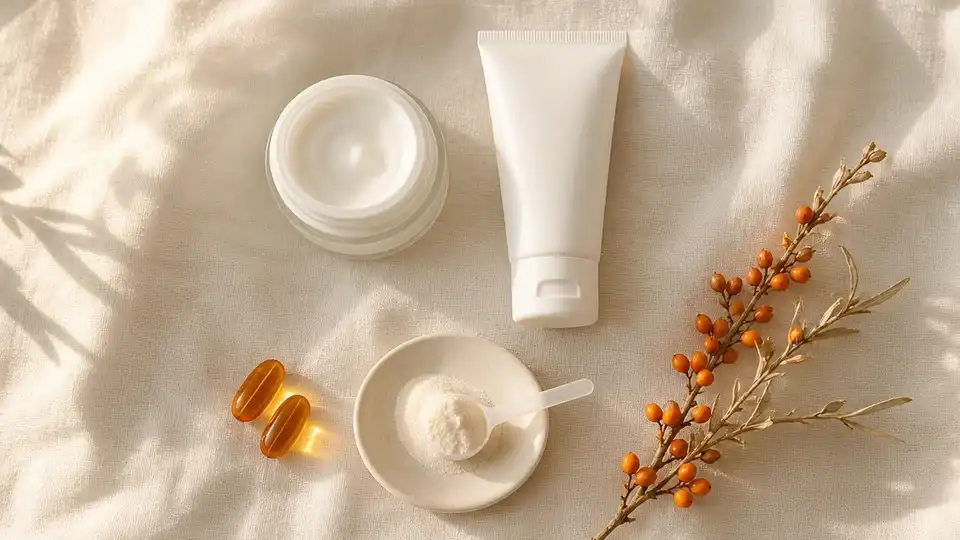
No law of nutrition says a hydrolyzed peptide and a sea buckthorn oil cannot be swallowed on the same day. They are not the same molecule. That is not evidence they “work on interior firmness and exterior moisture at the same time” as a tested pair.
Check both Supplement Facts for duplicate extras. Fish-collagen plus any oil still needs an allergy and medicine check. Pregnant, nursing, on drugs, or managing a condition: ask a healthcare professional [6]. Introduce one product first if you care which bottle you can credit.
Conclusion
Collagen peptides are hydrolyzed protein with dermal-matrix trials on specific peptides [1][3]. Skin Glow is a plant oil, not collagen, with a four-omega label and no disease claims [6]. Layers is a way to keep the jobs straight. It is not a scoreboard. Neither bottle replaces topical care or a diagnosis.
FAQ
Q: Can Skin Glow Supplement replace topical moisturizers?
No. The product page states it complements cleansing, moisturizing, and sun protection. It is not a cream and not a treatment for dry-skin conditions [6].
Q: Are these vegan softgels suitable for daily use?
The labeled serving is 2 vegan softgels daily as directed on the pack (15 servings per bottle). Organic sea buckthorn oil 1000 mg per serving. Confirm the physical label. Daily use is a label instruction, not a medical clearance [6].
Q: Can collagen peptides and sea buckthorn oil be taken together?
They are different nutrient classes, so many people take both. There is no published combination trial that proves extra results. Read both labels and ask a clinician if you take medicines or have a condition [6].
Elevate Your Skincare Routine with Laicuherb
Skin Glow Supplement is USDA Organic whole sea buckthorn oil, vegan softgels, omega-3/6/7/9 on the panel — not a collagen peptide and not a timeline for glow [6].
Skin Glow Supplement
USDA Organic | NSF cGMP | BRCGS | Non-GMO | Vegan
Label and current facts: Skin Glow Supplement. Questions: hello@laicuherb.com.
References
[1] Proksch, E., Schunck, M., Zague, V., Segger, D., Degwert, J., & Oesser, S. (2014). Oral intake of specific bioactive collagen peptides reduces skin wrinkles and increases dermal matrix synthesis. Skin Pharmacology and Physiology, 27(3), 113–119. https://pubmed.ncbi.nlm.nih.gov/24401291/
[2] Larmo, P. S., Järvinen, R. L., Setälä, N. L., et al. (2010). Oral sea buckthorn oil attenuates tear film osmolarity and symptoms in individuals with dry eye. The Journal of Nutrition, 140(8), 1462–1468. https://pubmed.ncbi.nlm.nih.gov/20554904/
[3] Asserin, J., Lati, E., Shioya, T., & Prawitt, J. (2015). The effect of oral collagen peptide supplementation on skin moisture and the dermal collagen network: Evidence from an ex vivo model and randomized, placebo-controlled clinical trials. Journal of Cosmetic Dermatology, 14(4), 291–301.
[4] Yang, B., & Kallio, H. P. (2001). Fatty acid composition of lipids in sea buckthorn (Hippophaë rhamnoides L.) berries of different origins. Journal of Agricultural and Food Chemistry, 49(4), 1939–1947. https://pubmed.ncbi.nlm.nih.gov/11308350/
[5] Yang, B., Kalimo, K. O., Mattila, L. M., et al. (1999). Effects of dietary supplementation with sea buckthorn (Hippophaë rhamnoides) seed and pulp oils on atopic dermatitis. Journal of Nutritional Biochemistry, 10(11), 622–630.
[6] Laicuherb. Skin Glow Supplement. https://www.laicuherb.com/beauty-fitness/skin-glow-supplement
Related Readings
Skin Glow Supplement with Collagen: Can You Take Both?
Omega-7 Supplement Dosage: No RDA, Study Ranges, and Label Use
Himalayan Sea Buckthorn Oil: How to Read a COA Before Buying
|
SJ
|
Dr. Sarah Jenkins Women's Health & Inner Beauty Nutrition Specialist Reviewed for botanical nutrition and cosmetic dermatology accuracy. This article reflects general health science and does not constitute medical advice. |